
The Supreme Court has directed the Central Bureau of Investigation (CBI) to examine all six allegations of financial irregularities levelled by the Enforcement Directorate against Sameer Gehlaut, former chairperson of Indiabulls Housing Finance (IHFL), and five corporate groups, following repeated criticism of investigating agencies for lack of progress.

The Supreme Court has appointed former Delhi High Court judge Justice Najmi Waziri as a mediator to resolve the cheque-dishonour dispute involving actor Rajpal Yadav. The legal battle originated from a 2010 financial agreement for his directorial debut, 'Ata Pata Laapata', where Yadav allegedly issued dishonoured cheques. The actor has deposited Rs 2 crore with the SC registry, and the court has allowed his passport release for professional commitments.

India's Next-Gen GST reforms are proving instrumental in driving robust economic growth, simplifying tax compliance, and fostering a more inclusive business environment across the nation, aligning with the vision of a 'Viksit Bharat', writes Finance Minister Nirmala Sitharaman.

'Read the prospectus as a capital allocator deciding whether the business deserves your capital at the offered price.'

Andhra Pradesh and Punjab National Bank (PNB) have signed an MoU to establish the PNB Quantum Finance Hub at Amaravati Quantum Valley. This initiative aims to foster innovation and adopt next-generation technologies like AI and Quantum Computing in the banking sector, focusing on cybersecurity, fraud detection, and customer experience.

The Kerala Legislative Assembly has passed a motion urging the central government to completely withdraw the proposed Merchant Discount Rate (MDR) on UPI transactions exceeding Rs 2,000. Chief Minister V D Satheesan and CPI MLA K Rajan highlighted concerns that the MDR would increase business costs, harm small businesses, and reduce the appeal of digital payments, while the BJP argued it would not affect general public or small merchants.

An Australian public servant of Indian origin, Suyash Sinha, has been arrested and denied bail in Canberra for allegedly stalking a woman and threatening to use government databases to obtain information about her and her family. Sinha, who became an Australian citizen last week, is accused of continuing to harass the woman after she rejected his advances, even claiming he could access her family's details through government systems. The case has been adjourned to November 4.

Finance Minister Nirmala Sitharaman stated that negotiations for the India-US trade agreement have reached a 'plateau', indicating limited scope for further concessions from either side, while also highlighting the US's aim to reduce its trade deficit with India.

While India and the US have narrowed their differences, the remaining issues will be the hardest to resolve

Marco Rubio will visit Mumbai and Jamnagar to discuss energy cooperation as S Jaishankar says India-US trade talks are nearing a landing point, with a few issues unresolved.

Two minors have been detained in Thane, Maharashtra, for allegedly murdering a 17-year-old boy. The motive behind the crime was to steal the victim's gold chain to fund a birthday party and purchase a motorcycle. The accused reportedly stabbed the victim, bludgeoned him with a stone, and later attempted to destroy evidence by burning the body and discarding the victim's mobile phone on a moving bus.

Opposition parties in Punjab have strongly criticised the Aam Aadmi Party (AAP) government following the murder of anti-drug activist Parminder Singh Jhota in Mansa. They allege a breakdown of law and order and "jungle raj," demanding accountability from Chief Minister Bhagwant Mann and a CBI probe into the killing. The incident has raised serious concerns about the safety of those fighting the drug menace in the state.

The GST Council, chaired by Finance Minister Nirmala Sitharaman, has begun deliberations on significant reforms, including decriminalising nine offences, softening provisions for 24, and raising the threshold for criminal prosecution to Rs 5 crore. The proposed changes also include scrapping the arrest powers of GST officers and introducing an 'invoice matching system' to combat fake input tax credit claims, aiming for a trust-based taxation approach and enhanced ease of doing business.

Kanpur police have uncovered a Rs 2.66-crore cyber fraud operation, leading to the arrest of two individuals and the identification of 89 bank accounts nationwide. The investigation began after a bank manager reported alleged fake complaints filed by one of the accused, Akhil Singh Chauhan, who was denied banking facilities. The fraud involved a fake investment scheme that targeted an exporter, with money routed through numerous mule accounts.

Indian banks are projected to achieve healthy profit growth in the second quarter of financial year 2027 (Q2FY27), driven by lower credit costs, robust advance growth, and fee income. However, net interest margins (NIMs) are expected to face pressure due to significant mobilisation of foreign currency non-resident (bank) FCNR(B) deposits.

Indian benchmark indices Sensex and Nifty saw a significant rebound in early trade, with the Sensex surging over 700 points, driven by a decline in crude oil prices, easing concerns over Federal Reserve tightening, and the appointment of Anup Bagchi as the new MD and CEO of HDFC Bank.

Union Minister H D Kumaraswamy has alleged that Karnataka Chief Minister D K Shivakumar met a person linked to sting operations and demanded a probe into the targeting of five Cabinet ministers. Kumaraswamy questioned the state government's inaction and sought clarification on the identity of the person and the purpose of the meeting. The Leader of Opposition also called for an FIR and investigation into the matter.

India's private sector capital expenditure is projected to reach approximately 3.2 trillion in the financial year 2026-27, up from 2.6 trillion in FY26, according to a Reserve Bank of India bulletin report, indicating sustained confidence despite global uncertainties.

The Economic Offences Wing (EOW) of the Crime Branch has filed a chargesheet against four individuals in a 16-year-old fraud case involving Johar Veer Goga (JVG), an unauthorised non-banking finance company in Jammu. The case stems from an investor's complaint in 2010 regarding an unpaid fixed deposit from 1996-97, revealing that JVG operated without proper regulatory registration.

Coal India Ltd (CIL) has refuted claims by NTPC Ltd regarding critically low coal stocks, stating it has met and exceeded its contractual supply commitments to the power producer. CIL reported supplying 97 million tonnes to NTPC and its joint ventures during April-September of FY27, a 5% increase year-on-year.

A special MPID court in Mumbai has framed charges against developer Vijay Machhindar, his wife, and their company Ornate Spaces Pvt Ltd for allegedly cheating homebuyers and investors of Rs 28 crore. The charges relate to failing to deliver flats in an Oshiwara residential project and not returning the invested money, leading to a trial under IPC, MPID, and MOFA provisions.

Boxing Federation of India president Ajay Singh has suspended secretary general Pramod Kumar with immediate effect. The suspension is pending an inquiry into alleged financial irregularities, non-cooperation with investigations, and misuse of authority. Allegations include unauthorised work orders for broadcasting and failure to cooperate with inquiries into championship cancellations.
The National Payments Corporation of India (NPCI) has deferred the implementation of a 0.4 per cent Merchant Discount Rate (MDR) on Person-to-Merchant UPI transactions above Rs 2,000. Originally set for October 15, the new date will be announced after Diwali, providing relief to users and merchants, especially during the festive season. The decision came amidst opposition concerns about the levy burdening consumers.

Rohan Bopanna, India's former world number one doubles player, has been excluded from the AITA's Sportspersons of Outstanding Merit (SOM) roster. This exclusion is due to his failure to meet the mandatory one-year retirement criterion, as he announced his professional retirement on November 1, 2025, just shy of the October 16, 2026, deadline for the roster. Despite inquiring about his eligibility and receiving initial assurance, his continued participation on the Pro ATP tour until October 2025 meant he was still considered active.

Opposition leaders from CPI-M and AAP faced detention in Delhi and Chandigarh while protesting against Chief Election Commissioner Gyanesh Kumar over serious allegations of voter-list manipulation and suppression of democratic rights.

A country that makes the isotope sets the timetable for everyone who needs it.

IBM India and South Asia MD Sandip Patel stated that India is at a defining moment with a unique opportunity to shape exponential technologies like artificial intelligence, emphasizing that "when India builds, it builds for billions," leading to scalable impact. Speaking at the IBM Think 2026 event, Patel highlighted that the AI revolution is still in its early stages, requiring enterprises to redesign their operations around agents, real-time data, automation, hybrid architecture, and trust. He also introduced the concept of "digital swaraj" or sovereignty in the Indian context, stressing the importance of control over operating environments, data, technology, and AI execution. IBM also announced an MoU with MeitY Startup Hub to accelerate India's deep tech innovation and startup ecosystem, providing startups access to IBM's technology expertise and platforms like watsonx and Sovereign Core.

Election-related freebies and populist measures are other factors crimping the revenue profile of these states.

The GST Council has approved a proposal allowing pharmaceutical companies to claim Input Tax Credit (ITC) on free samples and goods destroyed or written off due to expiry, effective from the next fiscal year. This move aims to support manufacturing, liquidity, and exports within the sector.

The Supreme Court has referred actor Rajpal Yadav's long-running cheque-dishonour dispute to mediation after he deposited Rs 2 crore with the court's registry. The court also directed the trial court to release his passport for professional commitments abroad. The dispute stems from a 2010 financial agreement for his directorial debut, leading to multiple cheque-bounce cases and a three-month imprisonment sentence upheld by the Delhi High Court.
Eighteen of India's 28 states exceeded the fiscal deficit ceiling of 3 per cent of GSDP in FY25, a deterioration comparable to the Covid year of 2020-21, according to the Comptroller and Auditor General (CAG). The report also noted a decline in states reporting a revenue surplus, with Bihar, Mizoram, and Telangana moving into deficit.

American singer Mary Millben has become a prominent figure in Indian political discourse due to her outspoken support for Prime Minister Narendra Modi, using social media to defend him against critics and appeal to young Indians, despite her musical career being less known in the country.

The Supreme Court advised actor Rajpal Yadav to make good movies and entertain people to rebuild his image, as it acknowledged his payment of Rs 1.15 crore in a long-running cheque-bounce case. The court also noted a prospective buyer for his property willing to deposit Rs 85 lakh. Yadav expressed financial losses from his film 'Ata Pata Laapata' and the impact on his career.

Police in Kerala have arrested four individuals, including the driver, in connection with a fatal Mini Cooper crash that killed three youngsters. The driver, Suhail, was allegedly under the influence of alcohol and driving at high speed. The victims' family is demanding that murder charges be invoked against the accused, while the Excise Department has registered cases against three bars for serving alcohol to underage individuals.

India remains one of the Hyundai Motor group's most important and strategic markets globally. The initiative positions India as a strategic core market for the group's growth, emerging market expansion, and next-generation automotive innovation.
The GST Council is set to discuss the application of GST on merchant fees for UPI transactions exceeding Rs 2,000. This comes as a new Merchant Discount Rate (MDR) of 0.4% (capped at Rs 300) is effective from October 15 for such transactions, which, as a service, would typically attract an 18% GST levy. The Council's decision is anticipated to consider consumer interests, with merchants potentially able to claim Input Tax Credit.

Life Insurance Corporation of India (LIC) is facing a thinning of its top management as Managing Director Dinesh Pant exits to join Irdai, leaving one of four MD posts vacant. This comes amidst broader staffing challenges across several public sector insurers and a headless Financial Services Institutions Bureau (FSIB).

Public and private sector banks in India experienced significant deposit growth in the July-September quarter of FY27, largely propelled by foreign currency non-resident (bank), or FCNR(B), deposits mobilised under the Reserve Bank of India's concessional swap window, which closed on August 31.

AAP workers in Mohali protested against Enforcement Directorate search operations at the GMADA office, alleging misuse of central agencies by the BJP-led Centre. The protests involved clashes with police and damage to property, while the ED's investigation targeted GMADA officials, an IAS officer, a realty company, and residences linked to political figures.
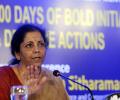
Finance Minister Nirmala Sitharaman has strongly refuted Opposition allegations that the decision to levy a 0.4 per cent Merchant Discount Rate (MDR) on specific UPI transactions above Rs 2,000 was influenced by external pressure. She clarified that the decision was a professional one made by the payment ecosystem, not a government imposition or a tax on consumers, with collected funds distributed among banks and UPI entities to ensure a sustainable digital payments framework.
